
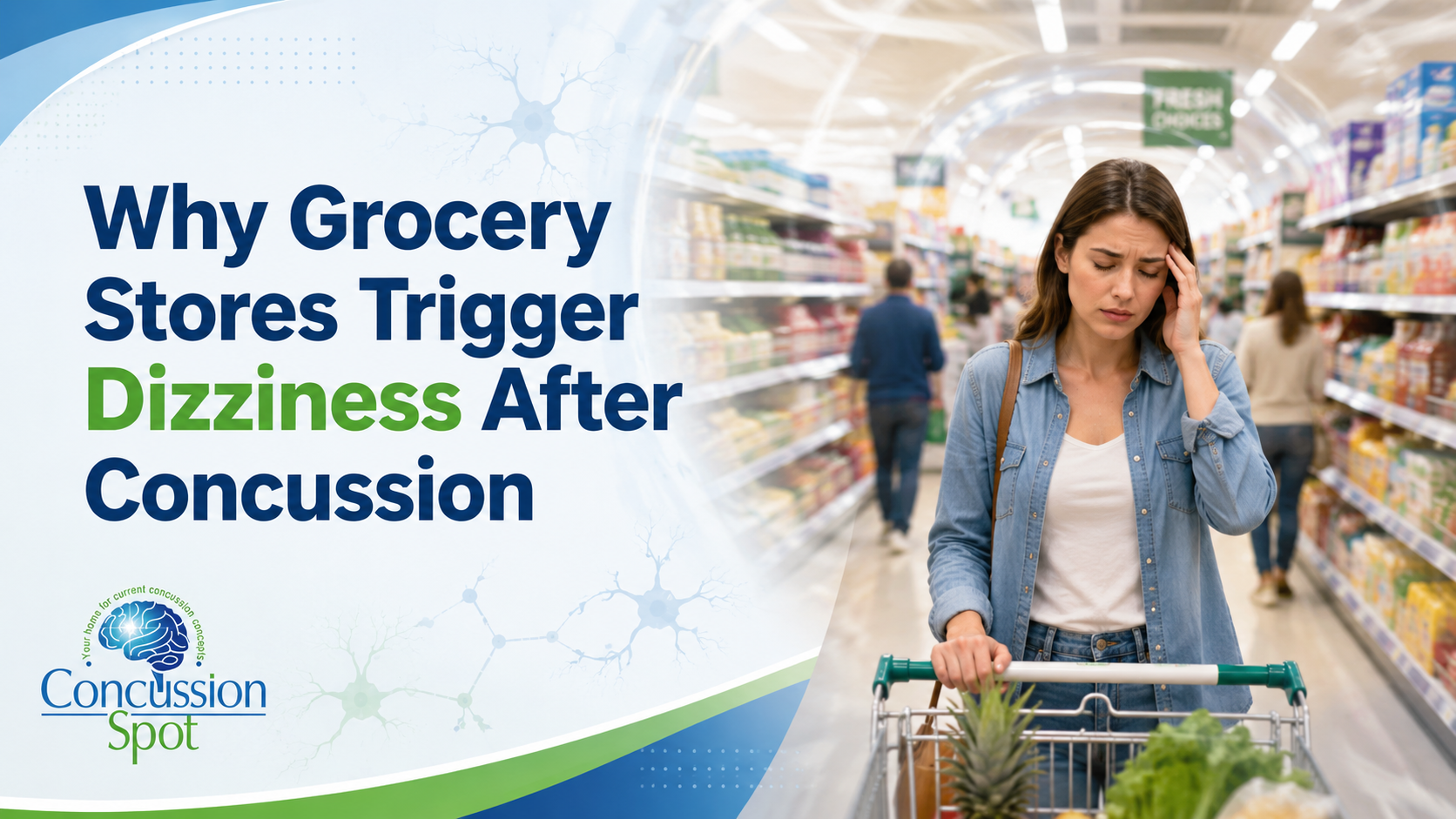
Many clinicians have heard a patient say something like this: “I feel okay at home, but as soon as I walk into a grocery store, I get dizzy, foggy, nauseated, or overwhelmed.”
This is one of the most common real-world complaints after concussion. It can also be easy to underestimate in the clinic because the patient may look relatively stable in a quiet treatment room. Balance testing may be improving. Eye movements may look better. Symptoms may be low at rest.
Then the patient walks into a grocery store, department store, gym, school hallway, or crowded event, and everything ramps up.
That response is not random. It often gives clinicians meaningful information about how the nervous system is tolerating real-world sensory load.
A Grocery Store Is a High-Demand Sensory Environment
A grocery store is not simply a place where someone walks and shops. From a concussion rehabilitation perspective, it is a visually complex, auditory-rich, cognitively demanding, and movement-based environment.
The patient is exposed to rows of patterned shelves, bright lights, carts moving through the visual field, people walking in multiple directions, overhead signs, music, announcements, scanning demands, and constant head and eye movement.
That is very different from sitting in a quiet room or walking down an empty hallway.
A helpful patient-friendly explanation is that the brain may be operating with a processing backlog after concussion. Visual, vestibular, auditory, and cognitive information may not be processed as efficiently as before the injury. When too much information enters the system at once, symptoms can increase.
Visual Motion Sensitivity Is Often Part of the Picture
One of the major contributors to grocery store dizziness is visual motion sensitivity. Patients with visual motion sensitivity often struggle when the visual environment is busy or moving, even if they are not moving themselves very quickly.
These patients may feel worse in grocery stores, big-box stores, crowds, scrolling environments, school hallways, sporting events, or while driving. The common thread is that the visual system is being asked to process a large amount of motion, depth, contrast, and competing sensory information.
However, it is important not to reduce every case of store-related dizziness to visual motion sensitivity alone.
Clinicians Need to Think in Systems
When a patient reports dizziness or symptom escalation in a busy store, the clinical goal is not to guess the cause. The goal is to evaluate the systems that may be contributing.
Visual motion sensitivity may be one factor, but other systems may be involved as well.
· Vestibular involvement: Does VOR testing provoke dizziness, nausea, imbalance, or visual instability?
· Oculomotor involvement: Does shelf scanning, reading labels, convergence, accommodation, or changing focus increase symptoms?
· Autonomic intolerance: Does walking through the store increase heart rate, fatigue, lightheadedness, or symptom load?
· Cervical contribution: Does head turning, sustained posture, or neck pain influence symptoms?
· Cognitive load: Does decision-making, multitasking, or navigating a busy environment increase fogginess or overwhelm?
The patient’s real-world complaint should guide the exam, but it should not replace the exam. A systems-based assessment helps identify what the patient can tolerate now and what needs to be progressed over time.
Identify the Patient’s Current Sensory Threshold
A key clinical target is the patient’s current sensory threshold. In other words, how much visual and sensory input can the patient tolerate before symptoms increase beyond an acceptable level?
Helpful clinical questions include:
· Can the patient tolerate two minutes in the store, five minutes, or fifteen minutes?
· Is a small local store easier than a large big-box store?
· Are quiet aisles manageable but crowded checkout lanes overwhelming?
· Does symptom increase come from walking, scanning, turning the head, lights, noise, or multitasking?
· How long does it take symptoms to return to baseline after exposure?
These details help establish a starting point for treatment. Without this step, clinicians may either underload the patient or overload the patient.
Avoidance Is Not the Long-Term Solution
One common mistake is telling patients to avoid grocery stores until they feel better. Avoidance may reduce symptoms in the short term, but it does not rebuild tolerance for real life.
The opposite mistake is pushing too hard too fast. If a patient goes into a store, symptoms spike severely, and they are wiped out for the rest of the day, the exposure was likely too much.
The better target is graded, symptom-guided progression. The goal is to help the nervous system gradually tolerate more input without repeatedly exceeding the patient’s current capacity.
Clinical Application: Building a Graded Store Tolerance Plan
A practical progression may start with lower-demand environments and slowly increase complexity. The exact plan should be individualized based on the exam and the patient’s symptom response.
Progression Variable
Lower Demand Starting Point
Possible Progression
Environment
Small store or quiet aisle
Larger store, busier aisle, big-box store
Time: Start with 2-5 minutes, and Progress to 10, 15, 20+ minutes
Visual scanning
Look straight ahead or scan one shelf
Scan multiple shelves, signs, and product labels
Head movement
Minimal head turns
Add head turns while walking and scanning
Cognitive load
Short list with a few items
Longer list, decision-making, price comparison
Busyness
Off-peak hours
Moderate traffic, then busier times
Support
Go with another person
Progress toward independent shopping
Early supports can be helpful when used strategically. A hat or sunglasses may reduce light sensitivity. A short list may reduce cognitive load. Shopping during off-peak hours may help control sensory intensity. Going with another person may reduce stress and decision-making demands.
These supports should not become permanent crutches. They are best used as temporary tools that allow the patient to participate while gradually rebuilding tolerance.
Treatment Progression Should Match the Exam
In-clinic treatment can support store tolerance by targeting the systems that reproduce symptoms. For example, a patient with gaze instability may need VOR progression. A patient who becomes symptomatic with shelf scanning may need oculomotor and visual scanning progression. A patient who is limited by walking tolerance or heart-rate response may need exertional progression.
The real-world goal is not simply to make symptoms lower in the clinic. The goal is to help the patient return to the environments that matter in daily life.
FAQ: Grocery Store Dizziness After Concussion
Why do grocery stores make patients dizzy after concussion?
Grocery stores can overload the visual, vestibular, auditory, and cognitive systems. Busy shelves, bright lights, movement in the background, scanning, walking, and decision-making can all increase symptom load.
Is grocery store dizziness always visual motion sensitivity?
No. Visual motion sensitivity is common, but clinicians should also evaluate vestibular, oculomotor, autonomic, cervical, and cognitive contributors.
Should patients avoid stores until they recover?
Complete avoidance may reduce symptoms short term, but it usually does not rebuild tolerance. A graded, symptom-guided progression is typically more useful than indefinite avoidance.
How should clinicians progress exposure to busy environments?
Start below the patient’s symptom threshold, then progress one variable at a time. Variables may include time, busyness, scanning demand, head movement, walking speed, cognitive load, and independence.
What is the main clinical takeaway?
Store-related dizziness is clinically meaningful. It can reveal difficulty with real-world sensory integration and should guide a systems-based concussion rehabilitation approach.
Key Takeaways
· Grocery store dizziness after concussion is a common and clinically meaningful complaint.
· Visual motion sensitivity is often involved, but it is rarely the only system clinicians should consider.
· A systems-based exam helps identify vestibular, oculomotor, autonomic, cervical, cognitive, and sensory contributors.
· The goal is to identify the patient’s current sensory threshold and build a graded progression from that point.
· Temporary supports can help patients participate, but the long-term goal is improved tolerance and return to real-world function.
Conclusion: Treat the Real-World Problem
When a patient says, “I get dizzy in grocery stores,” that should not be dismissed as a vague complaint. It is important clinical information. It tells you that the patient may be struggling with the sensory integration demands of real life.
Effective concussion rehabilitation is not just about reducing symptoms in a controlled clinic setting. It is about helping patients return to the environments they actually need to function in every day.
If you want to improve your clinical reasoning and treatment progression for patients with concussion, the Comprehensive Concussion Rehabilitation course walks clinicians through a systems-based assessment and treatment framework for concussion recovery, and you can learn more about our courses here.
You can also download the free Concussion Symptom Checklist to help identify symptom patterns and guide better clinical decision-making. Click here.