
Headache After Concussion: Identifying Primary and Secondary Drivers
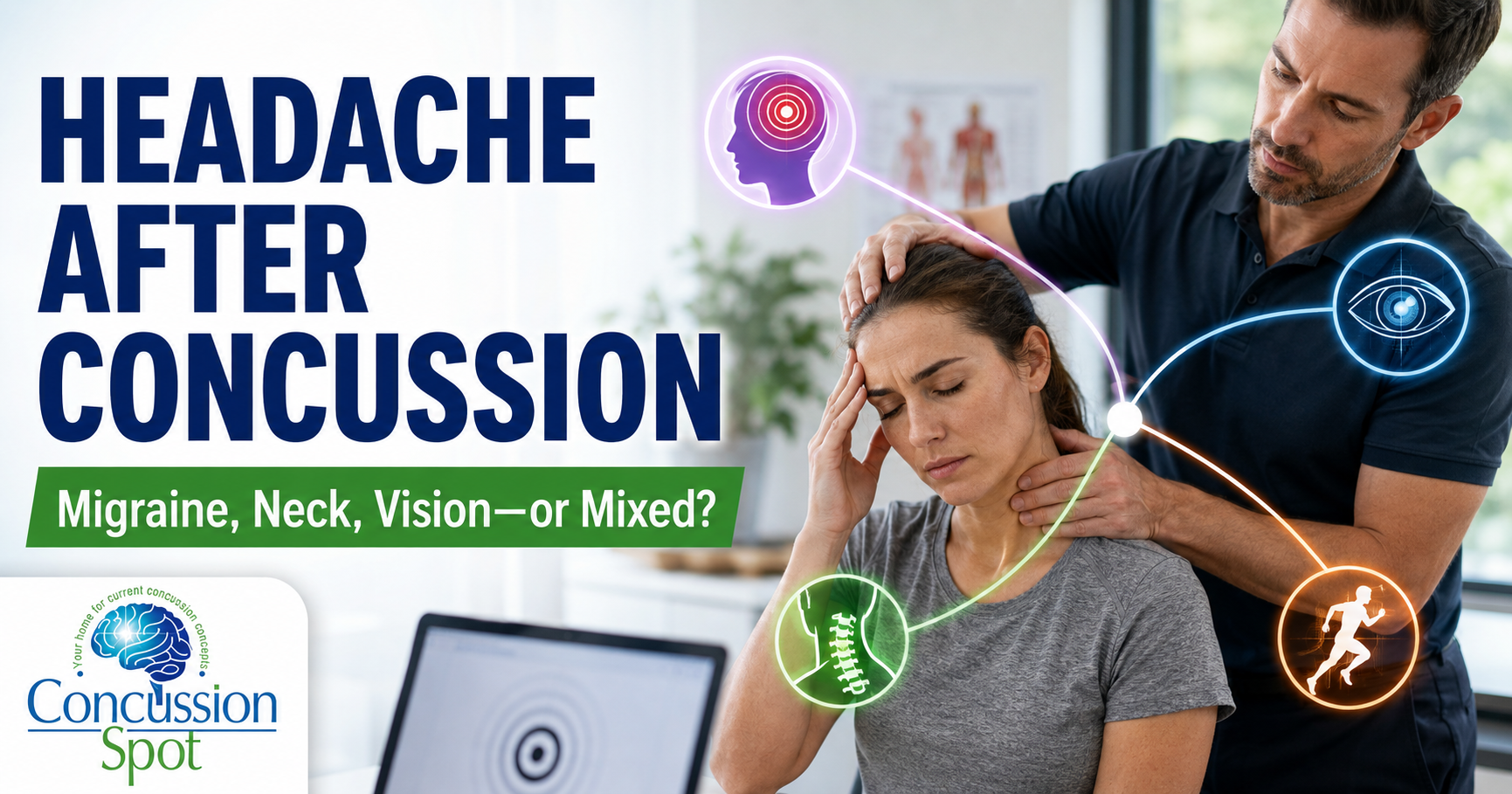
A patient reports a frontal headache every time they work on a computer. Is the primary driver visual, cervical, migraine-like, exertional, or a combination?
Pain location may help organize the history, but it cannot answer that question by itself. Cervical and visual dysfunction can both refer symptoms toward the forehead or eye, and a migraine-like phenotype may present in the same region. Effective post-traumatic headache management requires us to move beyond location and identify the dominant pattern, contributing systems, and factors that repeatedly lower the patient's headache threshold.
This article outlines a practical framework for safety screening, phenotype identification, systems assessment, treatment prioritization, and reassessment in rehabilitation practice.
Why Post-Traumatic Headache Is Clinically Challenging
Post-traumatic headache is classified primarily by its temporal relationship to a head or neck injury. That classification tells us when the headache began, but it does not define a single pain quality, mechanism, or treatment pathway. The clinical presentation may resemble migraine, tension-type headache, cervicogenic headache, or another headache phenotype.
The headache may also be influenced by impairments commonly seen after concussion, including cervical dysfunction, visual demand, vestibular symptoms, reduced exertional tolerance, sleep disruption, stress, and medication use. These overlapping factors make single-test or location-based diagnoses especially unreliable.
Clinical principle: Use the headache phenotype to organize the presentation, then identify the modifiable systems and contextual factors that trigger or amplify it.
Begin With Safety and Classification
Before examining rehabilitation drivers, screen for features that require urgent medical evaluation. These may include a sudden severe or rapidly worsening headache, progressive neurological findings, repeated vomiting, seizure, altered consciousness, significant cervical trauma, or concerning symptoms in a patient taking anticoagulant medication.
Next, establish the timeline and relevant history. Determine whether the headache began after the injury or represents a meaningful worsening of a pre-existing disorder. Review prior migraine, family history, current medication use, sleep, mood, hormonal factors when relevant, and other medical conditions that may change the differential diagnosis or plan of care.
The International Classification of Headache Disorders provides the diagnostic framework for headache attributed to head or neck trauma. Rehabilitation clinicians still need a functional systems assessment to determine which impairments are clinically meaningful and modifiable.
Identify the Dominant Headache Phenotype
Migraine-like phenotype
A migraine-like pattern may include throbbing or pulsating pain, nausea, photophobia, phonophobia, motion sensitivity, and worsening with routine activity. Dizziness or visual aura may also be present. A patient can develop this pattern after concussion even without a previous migraine diagnosis.
Cervical contribution
A cervical contribution becomes more likely when headache changes with neck movement, posture, or sustained positions; occurs with neck pain or restricted motion; and is reproduced through a relevant cervical examination. The examination may include upper-cervical mobility, flexion-rotation testing, muscle performance, and cervical sensorimotor control based on the history and irritability.
Visually provoked headache
Reading, screen use, tracking, convergence, accommodation, or visually complex environments may provoke headache. Symptom provocation during ocular testing is not sufficient by itself. Identify the specific visual deficit and consider competing explanations such as migraine sensitivity, cervical loading, task duration, and general symptom irritability.
Exertional and other patterns
A predictable headache increase above a physiological threshold may suggest exercise intolerance. A new severe exertional headache, syncope, chest symptoms, or neurological change requires medical assessment. Also consider tension-type features, occipital neuralgia, temporomandibular dysfunction, sleep disorders, medication-overuse headache, and psychological or contextual contributors.
Separate Primary and Secondary Drivers
A useful clinical model is to separate the dominant headache phenotype from the secondary factors that lower the patient's threshold. This avoids forcing a false choice between competing labels.
For example, a patient's dominant phenotype may be migraine-like, while poor sleep, dehydration, cervical pain, and visual demand repeatedly trigger or amplify symptoms. Another patient's primary driver may be cervical, while stress and prolonged screen exposure increase muscle guarding and sensitivity. Both patients may report frontal headache, but their treatment priorities will differ.
Documentation tip: Describe the dominant phenotype, the suspected contributing systems, and the functional triggers you plan to retest. This is more informative than documenting pain location alone.
A Practical Examination Framework
1. Screen red flags and establish the injury-to-headache timeline.
2. Characterize the phenotype: quality, distribution, frequency, duration, intensity, associated symptoms, and medication use.
3. Use the history to examine relevant systems, including cervical, vestibulo-ocular, visual, exertional, orthostatic, sleep, and mood factors.
4. Reproduce a meaningful task when safe. Reading, sustained desk posture, walking with head turns, or controlled aerobic exercise may be more informative than a resting symptom score.
5. Identify the highest-impact modifiable driver and select a functional marker to retest.
Treatment Prioritization
After urgent concerns have been addressed, prioritize the factor that is most severe, modifiable, and limiting to function. Care does not need to proceed in a rigid sequence. Many patients benefit from parallel medical, cervical, visual, vestibular, exercise, and behavioral strategies.
1. Cervical impairment: Consider manual therapy when appropriate, active mobility, deep cervical muscle performance, sensorimotor retraining, and graded postural tolerance.
2. Visual impairment: Treat the identified deficit rather than prescribing a generic set of eye exercises based only on symptom provocation.
3. Migraine-like phenotype: Coordinate medical management when indicated and address sleep, meals, hydration, sensory load, and graded restoration of activity.
4. Exercise intolerance: Use a symptom-informed, graded aerobic plan when medically appropriate and monitor the magnitude and duration of symptom response.
5. Possible medication overuse: Review frequency and coordinate with the prescribing clinician rather than directing medication changes outside your scope.
Clinical Application: Frontal Headache During Computer Work
Consider a patient who develops frontal headache after 20 minutes of computer work. Instead of assuming an ocular diagnosis, clarify the associated pattern. Is the pain throbbing and accompanied by photophobia? Does sustained cervical posture reproduce symptoms? Is there a specific convergence or accommodation deficit? Does the same headache emerge during aerobic exertion? How do sleep and medication use affect the threshold?
Choose an examination and treatment target that fits the strongest evidence from the history. Then retest a meaningful computer task under controlled conditions. The change in tolerance, symptom intensity, and recovery time helps determine whether the selected driver was clinically important.
Key Takeaways
1. Post-traumatic headache describes the relationship to injury, not a single headache mechanism.
2. Pain location is a clue, not a diagnosis.
3. Identify the dominant phenotype and the factors that lower the patient's symptom threshold.
4. Select tests from the history and use meaningful task reproduction when safe.
5. Prioritize the most severe, modifiable, functionally limiting driver, then treat and retest.
6. Coordinate medical and rehabilitation care when multiple drivers are present.
Frequently Asked Questions
Can headache location identify the source after concussion?
No. Frontal or retro-orbital pain may be associated with migraine, cervical dysfunction, visual demand, or a mixed presentation. Location should guide questions, not determine the diagnosis.
What is the difference between post-traumatic headache and migraine?
Post-traumatic headache is defined by its timing after injury. Its clinical phenotype may resemble migraine, tension-type headache, cervicogenic headache, or another pattern.
Does symptom provocation during ocular testing confirm a visual disorder?
No. Provocation indicates that the task is relevant, but the clinician still needs to identify a specific deficit and consider migraine sensitivity, cervical load, and task duration.
Should every headache flare stop rehabilitation?
Not necessarily. Mild, brief symptom increases may occur during graded rehabilitation. Large, escalating, or prolonged flares suggest that dosage should be modified or the presentation reassessed.
When should care be multidisciplinary?
Consider coordinated care when medical headache management, cervical or vestibular rehabilitation, visual care, sleep, behavioral health, or medication review are all clinically relevant.
Conclusion
Headache after concussion rarely has one simple source. A phenotype-informed, systems-based examination helps clinicians replace location-based guessing with a clearer explanation and a more targeted plan. Start with safety, identify the dominant pattern, examine the systems suggested by the history, and retest a task that matters to the patient.
Next step: Download the Concussion Spot Post-Concussion Symptom Checklist to structure the headache history. For deeper training in cervical, vestibular, ocular, exertional, and headache rehabilitation, explore the Concussion Spot Education online courses.
Sources and Further Reading
1. International Headache Society. ICHD-3: Headache attributed to trauma or injury to the head and/or neck. Open source
2. Patterson Gentile C, et al. American Headache Society white paper on treatment of post-traumatic headache from concussion in youth. Headache. 2024;64(9):1148-1162. Open source
3. Patricios JS, et al. Consensus statement on concussion in sport: the 6th International Conference on Concussion in Sport. Br J Sports Med. 2023;57:695-711. Open source