
Dizziness After Concussion: A Systems-Based Clinical Framework
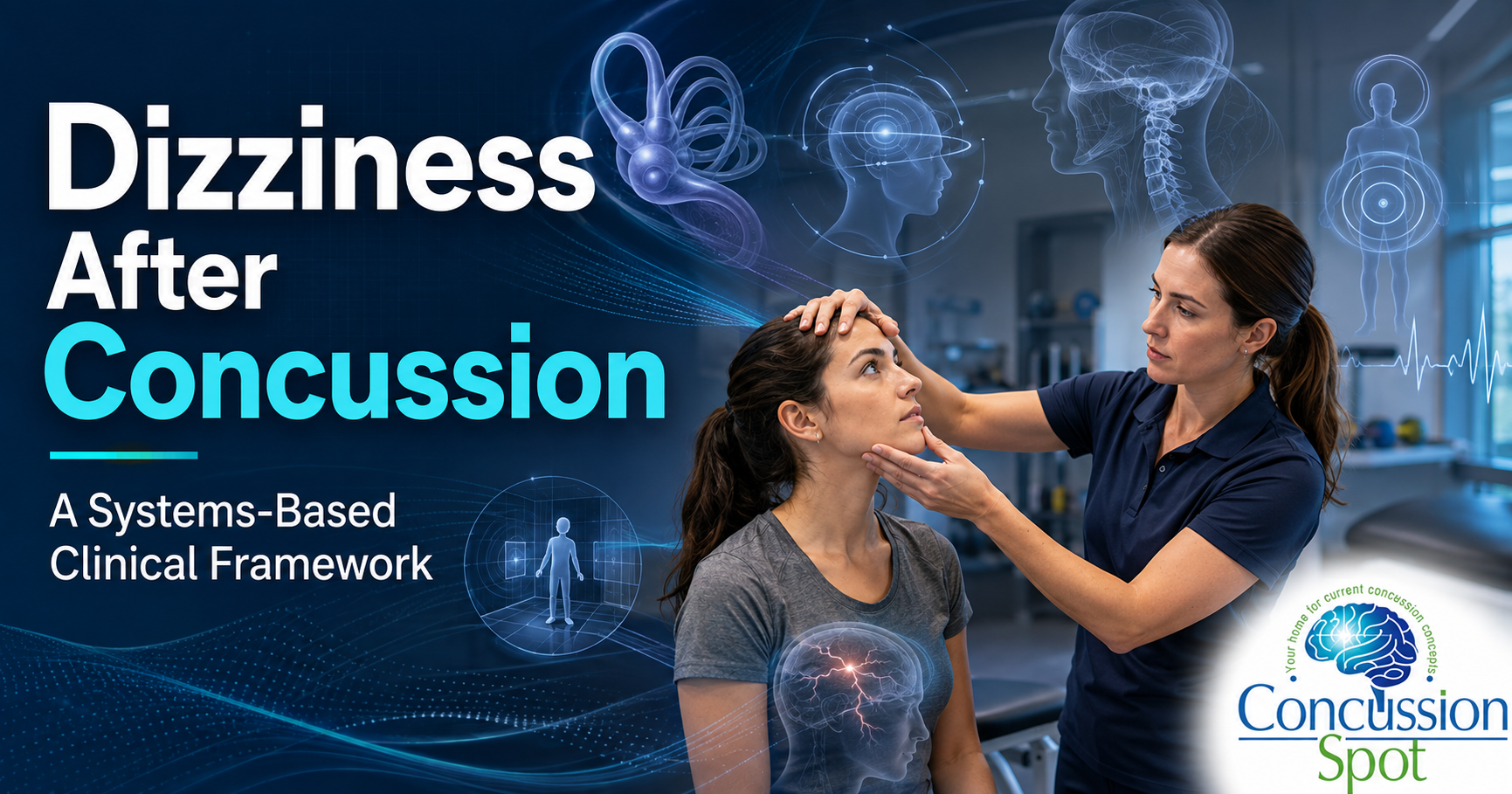
A patient says, "I get dizzy whenever I move my head." That statement sounds specific, but it can point toward several very different problems: post-traumatic BPPV, peripheral vestibular dysfunction, visual motion sensitivity, cervicogenic dizziness, migraine, autonomic intolerance, anxiety, or a combination of contributors.
The challenge is not simply selecting an exercise. It is determining which findings are clinically meaningful, which system is creating the greatest functional limitation, and what should be treated first. A systems-based approach helps clinicians move beyond the symptom label and build a focused rehabilitation plan.
Dizziness Is a Symptom, Not a Diagnosis
Patients use the word dizziness to describe vertigo, disequilibrium, presyncope, visual disorientation, nausea, floating, or cognitive overwhelm. If the experience is not clearly defined, the examination can become a checklist of tests rather than a hypothesis-driven process.
Overlap makes the presentation even more complex. A patient may have post-traumatic BPPV and cervical dysfunction. Visual motion sensitivity may coexist with vestibular hypofunction or migraine. Anxiety may amplify symptoms without being their sole cause. One positive finding rarely explains every limitation.
Start by Defining the Dizziness Phenotype
Begin with quality, timing, triggers, duration, and associated symptoms. These details help organize the differential before testing begins.
· Brief vertigo with rolling, lying back, or looking up raises suspicion for BPPV.
· Dizziness or blurred vision during head movement may suggest vestibular involvement, although neck pain can complicate head-movement testing.
· Symptoms in grocery stores, crowds, traffic, or while scrolling suggest visual motion sensitivity.
· Lightheadedness with standing or exertion should prompt consideration of orthostatic response and exercise tolerance.
· Photophobia, phonophobia, nausea, motion sensitivity, and episodic headache may fit a migraine phenotype.
· Neck pain, stiffness, limited motion, headache, or symptom change with head-on-trunk movement increases suspicion for cervical involvement.
· Persistent rocking or swaying that is worse upright or in complex visual environments may warrant consideration of persistent postural-perceptual dizziness.
Build a Systems-Based Examination
Once the phenotype is clear, select tests that can confirm, challenge, or refine the working hypothesis. The examination should be broad enough to identify overlapping contributors but focused enough to remain clinically useful.
1. Screen for urgent and medical contributors
Complete the appropriate neurological, cervical, and medical red-flag screen. Also review medication effects, migraine features, sleep, and other factors that may influence the presentation.
2. Test for BPPV when the history supports it
Use canal-specific positional testing. Post-traumatic BPPV may be bilateral, multicanal, or recurrent, so reassess after treatment rather than assuming one maneuver has resolved the problem.
3. Examine vestibulo-ocular and balance function
Depending on the clinical setting, examination may include ocular alignment, spontaneous and gaze-evoked nystagmus, head impulse testing, dynamic visual acuity, gaze stability, motion sensitivity, and balance under altered sensory conditions.
4. Assess visual and visual-motion responses
Symptom provocation during saccades, pursuits, convergence, or optokinetic input provides useful information, but provocation alone does not establish the underlying impairment. Consider visual acuity, binocular function, migraine, attention, and cervical contribution.
5. Do not skip the cervical and exertional systems
Include cervical range of motion, upper-cervical mobility, muscle performance, joint-position sense, and head-neck differentiation when appropriate. Assess orthostatic response and exertional tolerance when symptoms occur with standing or physical activity.
Prioritize Treatment Without Becoming Rigid
Rigid sequencing rules are rarely appropriate for every patient. Start with conditions that are dangerous, highly limiting, or readily treatable. If BPPV is present, treat it promptly because positional vertigo can interfere with nearly every other exercise. However, the patient may still be able to continue safe cervical care, education, aerobic activity, or low-provocation rehabilitation while BPPV is reassessed.
Next, identify the impairment creating the greatest functional barrier. A patient who cannot turn the head because of neck pain may need cervical treatment before meaningful gaze-stability progression. Clear vestibular hypofunction may call for adaptation exercises. A patient dominated by visual motion sensitivity may need graded optokinetic and real-world exposure.
When several systems are involved, avoid prescribing a full program for every positive test. Choose a small treatment set, establish a tolerable dose, and retest a meaningful functional task.
Dose Graded Exposure Deliberately
Adaptation, habituation, substitution, and sensory reweighting require exposure, but "provoke symptoms" is not a complete dosage instruction. Manipulate duration, speed, range, stance, background complexity, and cognitive load. Aim for a manageable increase in symptoms that begins returning toward baseline within a reasonable period.
If symptoms continue escalating across the day or function declines, reduce the dose and revisit the working diagnosis. Symptom response is not only an outcome; it is data that should refine the plan.
Address Anxiety Without Psychologizing the Presentation
Anxiety can increase visual vigilance, muscle tension, autonomic arousal, and fear of movement. These responses can amplify dizziness and slow exposure-based recovery. Explain the interaction without dismissing the symptoms as "just anxiety." Breathing strategies, cognitive behavioral support, and coordinated mental-health care can occur alongside physical rehabilitation.
Clinical Application: A Five-Step Workflow
1. Define the dizziness phenotype using quality, timing, triggers, duration, and associated symptoms.
2. Screen for red flags and test for BPPV when indicated.
3. Examine vestibular, visual, cervical, balance, orthostatic, and exertional systems according to the working hypothesis.
4. Identify the leading functional limiter and select a focused treatment set.
5. Retest a task that matters to the patient and update the hypothesis based on the response.
Clinical reminder: The goal is not to eliminate every positive test before function improves. The goal is to identify the findings that matter and help the patient return to walking, working, driving, exercising, and tolerating complex environments.
Key Takeaways
· Post-concussion dizziness is a symptom category, not a single diagnosis.
· Define the phenotype before selecting tests or exercises.
· BPPV, vestibular, visual, cervical, migraine, autonomic, and psychological contributors may coexist.
· A positive symptom-provocation test does not automatically identify the source.
· Prioritize safety, high-impact impairments, and readily treatable conditions while addressing independent systems as tolerance allows.
· Use a small intervention set, deliberate dosage, and functional retesting to guide progression.
Frequently Asked Questions
Is dizziness after concussion always vestibular?
No. Vestibular dysfunction is one possibility, but BPPV, cervical dysfunction, visual motion sensitivity, migraine, orthostatic intolerance, medication effects, and anxiety may also contribute.
Should BPPV be treated before all other concussion rehabilitation?
BPPV should be treated promptly when present, but safe care for independent impairments may often continue while positional vertigo is reassessed.
Does symptom provocation during an oculomotor screen confirm the diagnosis?
No. Provocation is useful clinical information, but it does not identify the underlying impairment by itself. Interpret it within the complete history and examination.
How much symptom increase is acceptable during rehabilitation?
There is no universal number for every patient. Use a manageable, short-lived increase, monitor the recovery toward baseline, and reduce the dose if symptoms accumulate or function declines.
Where does aerobic exercise fit?
Symptom-guided aerobic exercise can be integrated when medically appropriate, particularly when exercise intolerance or prolonged inactivity is contributing to reduced function.
Conclusion
The most useful question is not, "Which dizziness exercise should I prescribe?" It is, "Which systems are contributing, which finding is limiting function, and how will I know the intervention is working?" A systems-based differential makes treatment more specific without forcing every patient into the same sequence.
Next Step: Download the free Concussion Spot Post-Concussion Symptom Checklist to structure the history and guide a more focused examination. For deeper training in vestibular, ocular, cervical, and exertional concussion rehabilitation, explore the online courses from Concussion Spot Education.
Evidence-Informed Sources
Patricios JS, et al. Br J Sports Med. 2023;57:695-711. Open consensus statement
Gianoli GJ. Front Neurol. 2022. Open clinical review
Quatman-Yates CC, et al. J Orthop Sports Phys Ther. 2020;50:CPG1-CPG73. Open clinical practice guideline