
Cervicogenic Dizziness After Concussion
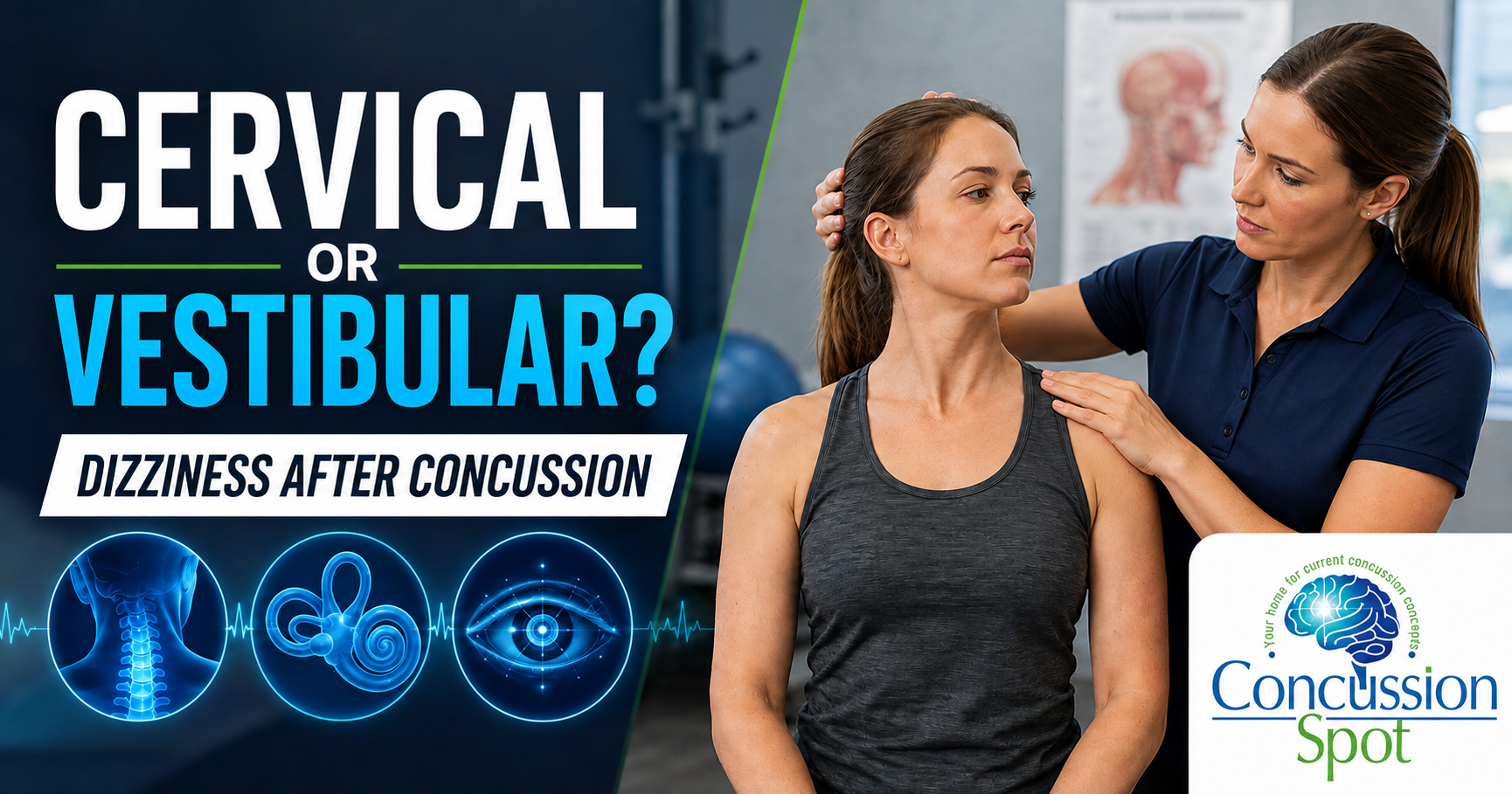
A patient presents several weeks after concussion with dizziness during head movement, visual overload in busy environments, and unsteadiness while walking. Gaze-stability and habituation exercises repeatedly increase dizziness, yet function barely changes.
Does the patient need more vestibular exposure, a different dosage, or a cervical examination that changes the working hypothesis?
Cervicogenic dizziness can be missed after concussion because its features overlap with vestibular, oculomotor, migraine, autonomic, and exertional presentations. The practical solution is not to label the symptoms from one provocative test. It is to examine how cervical input fits within the larger sensory-control system and look for converging evidence.
“Clinical bottom line: Treat cervicogenic dizziness as a testable hypothesis supported by symptom behavior, cervical findings, differentiation testing, reasonable exclusion of competing causes, and meaningful reassessment.”
Why Clinicians Struggle With Cervicogenic Dizziness
The first challenge is language. Dizziness is a symptom, not a diagnosis. Patients may use the same word to describe vertigo, disequilibrium, lightheadedness, or visual disorientation. If the experience is not defined at the beginning of the evaluation, the differential remains unnecessarily broad.
The second challenge is the lack of an accepted gold-standard test. Cervicogenic dizziness remains a clinical diagnosis. A defensible hypothesis typically includes a relationship between dizziness and cervical pain or dysfunction, supportive examination findings, reasonable exclusion of competing causes, and ideally a meaningful response to targeted intervention.
The third challenge is coexistence. A patient can have BPPV and cervical dysfunction, visual motion sensitivity plus impaired cervical proprioception, or exertional intolerance complicated by neck pain. An either-or framework can be just as limiting as overlooking the neck.
A Systems-Based Explanation
The cervical spine provides continuous proprioceptive information about head position relative to the trunk. The central nervous system integrates this input with visual and vestibular information to support gaze stability, balance, and spatial orientation.
The upper cervical region deserves particular attention because of its role in head-on-trunk control and sensorimotor processing. Following acceleration-deceleration trauma, pain, restricted mobility, altered recruitment, reduced endurance, and impaired joint-position sense can change the quality of cervical afferent input.
When cervical information conflicts with visual or vestibular information, the patient may experience dizziness, disorientation, or unsteadiness. This mechanism supports examining the upper cervical region, but it does not justify telling every patient that C1-C3 is the source. The stronger message is that cervical dysfunction may be one contributor within a multisystem presentation.
Differential Diagnosis: Start With the Dizziness Phenotype
Before selecting tests, define the symptom. Document its quality, timing, duration, triggers, associated features, injury mechanism, and relationship to neck symptoms.
· Brief positional vertigo with rolling, lying back, or looking up should increase suspicion for BPPV.
· Oscillopsia, reduced dynamic visual acuity, or an abnormal head impulse may support peripheral vestibular involvement.
· Symptoms in complex visual environments may suggest visual motion sensitivity, although this can coexist with cervical dysfunction.
· Lightheadedness with standing or exertion should move autonomic or exercise intolerance higher on the differential.
· Episodic dizziness with photophobia, phonophobia, motion sensitivity, or migraine history may fit a migraine phenotype.
· Neurological, vascular, or serious cervical findings require appropriate medical referral.
The cervical hypothesis moves higher when dizziness changes with neck pain or stiffness, sustained posture, head-on-trunk movement, restricted or painful motion, impaired upper-cervical mobility, altered joint-position sense, or symptom reproduction during tests that isolate cervical input. No single finding closes the case.
Evaluation: A Practical Five-Step Sequence
1. Define the symptom and screen for red flags. Clarify the dizziness phenotype and document the relationship between the injury mechanism, neck symptoms, and dizziness.
2. Complete the multisystem concussion screen. Include positional testing when indicated, vestibulo-ocular function, balance, visual motion sensitivity, exertional tolerance, migraine features, and relevant neurological findings.
3. Examine the cervical spine. Assess active motion and symptom response, upper-cervical mobility—including C1-C2 rotation when appropriate—muscle tenderness, deep neck flexor and extensor function, and cervical joint-position error.
4. Use differentiation testing as part of a cluster. The seated cervical torsion test may help separate head movement from neck movement. The smooth pursuit neck torsion test may add information in selected whiplash-associated presentations, but performance varies, and it should not stand alone.
5. Retest a meaningful task. Determine whether a targeted cervical intervention changes dizziness during head turns while walking, reading, driving simulation, work tasks, or a visual-vestibular exercise.
Treatment Implications
Treatment should match the impairments identified during the examination rather than a generic cervicogenic dizziness protocol.
· Restricted mobility may support appropriately dosed manual therapy combined with active motion.
· Impaired deep neck flexor or extensor performance supports motor-control and endurance training.
· Joint-position error supports cervical proprioceptive retraining.
· Difficulty coordinating the eyes, head, and trunk may require graded sensorimotor integration.
· Coexisting vestibular dysfunction may require vestibular rehabilitation delivered in parallel with cervical care.
VOR training is usually not clinically useful when pt is still testing positive for cervicogenic dizziness. Head movement during VOR exercises can load an irritable neck and obscure progress.
If the examination also demonstrates an independent vestibular deficit, cervical and vestibular rehabilitation can often proceed together. The clinician should know what is being dosed, what response is expected, and which functional task will be reassessed.
Also monitor stretching dosage. If a cervical stretch repeatedly produces substantial dizziness, reduce the intensity and reconsider the target. General stretching alone is unlikely to address a combination of mobility, motor-control, proprioceptive, and endurance deficits.
Common Clinical Mistakes
· Using the word dizziness without defining the patient’s actual experience
· Assuming all post-concussion dizziness is vestibular—or assuming all dizziness with neck pain is cervicogenic
· Using one provocative cervical test as a stand-alone diagnosis
· Treating a multisystem presentation as an either-or decision
· Applying generic stretching or manual therapy without linking treatment to identified impairments
· Failing to retest a meaningful functional task after intervention
What Does the Evidence Suggest?
The Amsterdam international consensus recommends individualized cervicovestibular rehabilitation for adolescents and adults with dizziness, neck pain, or headache persisting beyond 10 days after concussion. The implementation message is to identify and treat contributing systems rather than simply extending rest.
In a 2014 randomized controlled trial, Schneider and colleagues reported that adolescents and young adults with persistent dizziness, neck pain, or headache were more likely to receive medical clearance within eight weeks when cervical and vestibular rehabilitation were added to the comparison program. The study was small, so the magnitude of benefit should be interpreted cautiously, but it supports combined care in a selected population.
A 2022 systematic review and meta-analysis by De Vestel and colleagues found moderate-quality evidence that manual therapy can reduce cervicogenic dizziness and associated cervical and balance symptoms. Manual therapy combined with exercise may provide additional benefit, although certainty for that conclusion was very low. Multimodal care is reasonable, but the evidence should not be oversold.
Frequently Asked Clinical Questions
Is cervicogenic dizziness a diagnosis of exclusion?
Competing vestibular, neurological, vascular, migraine-related, and exertional causes must be considered, but the process should also seek positive evidence supporting a cervical contribution. The goal is converging evidence, not merely a list of negative tests.
Which test confirms cervicogenic dizziness?
No single test confirms the diagnosis. Cervical torsion, head-neck differentiation, joint-position error, mobility, muscle performance, symptom behavior, and response to intervention should be interpreted as a cluster within a multisystem examination.
Should vestibular rehabilitation wait until the neck is normal?
Not necessarily. If vestibular and cervical impairments coexist, both can often be treated in parallel. Modify vestibular exercises when cervical loading clouds the response, and reassess function to guide progression.
Does neck pain have to be severe?
No. Stiffness, fatigue, headache, altered posture tolerance, limited movement, or impaired sensorimotor control may be clinically meaningful even when pain intensity is modest.
What outcome measures matter most?
Use impairment measures to guide treatment, but anchor reassessment to meaningful function: head turns during gait, reading tolerance, driving simulation, work tasks, exercise, and tolerance of visually complex environments.
Key Takeaways
· Cervicogenic dizziness is a clinical hypothesis, not a finding established by one test.
· Define the dizziness phenotype before narrowing the differential.
· Cervical, vestibular, visual, migraine-related, and exertional impairments frequently coexist after concussion.
· Match treatment to mobility, motor-control, proprioceptive, endurance, and sensorimotor findings.
· Use meaningful reassessment to determine whether the cervical intervention changes function.
Conclusion
Not all dizziness after concussion comes from the concussion itself, and not all dizziness with neck pain comes from the cervical spine. The most defensible approach is to treat cervicogenic dizziness as a testable hypothesis within a multisystem examination.
When symptom behavior, cervical findings, differentiation testing, and response to treatment align, the neck may be a meaningful contributor. When another system is also involved, integrate the plan rather than forcing the patient into one category.
Ready to Strengthen Your Concussion Practice?:Download the free Concussion Spot Post-Concussion Symptom Checklist to structure the symptom presentation. To go deeper into cervical, vestibular, ocular, exertional, and other post-concussion systems, explore the online courses available through Concussion Spot Education. [Insert links before publishing]
References
Patricios JS, et al. Consensus statement on concussion in sport: the 6th International Conference on Concussion in Sport. British Journal of Sports Medicine. 2023;57:695-711.
Schneider KJ, et al. Cervicovestibular rehabilitation in sport-related concussion: a randomised controlled trial. British Journal of Sports Medicine. 2014;48:1294-1298.
De Vestel C, et al. Systematic review and meta-analysis of the therapeutic management of patients with cervicogenic dizziness. Journal of Manual & Manipulative Therapy. 2022;30:273-283.
Nuesch A, et al. Validation of the Cervical Torsion Test and Head-Neck Differentiation Test in patients with peripheral vestibular hypofunction. Physical Therapy. 2024.