
Can We Prevent Concussions?
You’ve probably heard someone say, “You can’t prevent concussions.”
There is some truth to that statement. No helmet, mouthguard, exercise program, or rule change can eliminate concussion risk completely. Concussions occur in dynamic, unpredictable environments, especially in sports where speed, contact, falls, and collisions are part of participation.
But the more useful clinical question is not, “Can we prevent every concussion?”
A better question is:
Can we reduce concussion risk?
And the answer is yes.
For healthcare professionals working with athletes, patients, schools, and sports organizations, this distinction matters. We should avoid overpromising prevention, but we should also avoid the opposite mistake: assuming nothing can be done.
The goal is not concussion-proofing an athlete. The goal is to lower risk through evidence-informed, practical, and repeatable systems.
Why Concussion Risk Reduction Matters
Concussions can affect far more than sport participation. They can influence how a person thinks, feels, learns, sleeps, moves, and interacts with the world around them.
For athletes, concussions may affect school performance, mood, reaction time, visual function, vestibular function, exertional tolerance, and confidence returning to play. For clinicians, this reinforces the importance of thinking beyond diagnosis and return-to-play timelines.
Concussion care should include both management after injury and risk-reduction strategies before injury.
This is where clinicians can have a major impact.
We can educate athletes, parents, coaches, and organizations on strategies that may reduce risk while also improving performance, durability, and long-term participation.
Strategy 1: Use the Right Head Protection
Helmets do not make athletes concussion-proof.
That is one of the most important messages clinicians should communicate clearly. A helmet can help reduce certain forces and protect against skull fractures and other head injuries, but it cannot eliminate the acceleration and rotational forces associated with concussion.
That said, helmet selection still matters.
Independent helmet testing, such as the Virginia Tech Helmet Lab ratings, helps evaluate how well different helmets may reduce concussion risk in specific sports. When possible, athletes should use helmets with strong independent safety ratings, such as 4- or 5-star options.
But clinicians should also emphasize that the “best” helmet is not automatically the most expensive one.
A good helmet should be:
Designed for the specific sport
Properly fitted
Worn consistently
Maintained according to manufacturer guidelines
Replaced when damaged or expired
From a clinical implementation standpoint, the message should be simple:
A helmet is one layer of risk reduction, not a guarantee of protection.
This framing helps families and athletes make informed choices without developing a false sense of security.
Strategy 2: Use Mouthguards When Recommended or Required
Mouthguards are commonly viewed as dental protection, and that remains their primary role. They help protect the teeth, lips, jaw, and oral structures during sport.
However, some research in ice hockey has found that mouthguard use was associated with a lower concussion rate across age groups. This does not mean mouthguards prevent every concussion, and clinicians should be careful not to oversell them as a stand-alone prevention tool.
Instead, mouthguards should be presented as another layer in a broader risk-reduction system.
For athletes in sports where mouthguards are required or recommended, clinicians can reinforce the importance of consistent use. Like helmets, mouthguards only help when they are actually worn, properly fitted, and appropriate for the sport.
The practical message:
Mouthguards are not magic, but they may contribute to risk reduction while also protecting the teeth and jaw.
Strategy 3: Implement a Quality Neuromuscular Warmup
One of the most practical and underused concussion risk-reduction strategies is a structured neuromuscular warmup.
This is more than jogging a lap and doing a few static stretches.
A true neuromuscular warmup includes elements such as:
Balance
Strength
Trunk and hip control
Jumping and landing mechanics
Cutting and change-of-direction control
Sport-specific movement patterns
Feedback on movement quality
This type of warmup matters because many injury mechanisms involve poor control of body position, reduced awareness, poor deceleration, or inefficient movement strategies under speed and fatigue.
Research in schoolboy rugby players found that teams performing a movement-control warmup at least three times per week had a substantial reduction in overall match injuries and a significant reduction in concussions.
The key detail is not just that the athletes “did a warmup.”
The key is that they performed it consistently and with attention to movement quality.
That is where clinicians, athletic trainers, strength coaches, and sport coaches can collaborate. The goal is not to add a long, complicated program that no one will use. The goal is to build a repeatable system that fits naturally into practice.
A practical framework may include:
Dynamic mobility and activation
Balance or single-leg control
Strength-based movement patterns
Jumping and landing control
Cutting, deceleration, or sport-specific movement
Coach or clinician feedback on technique
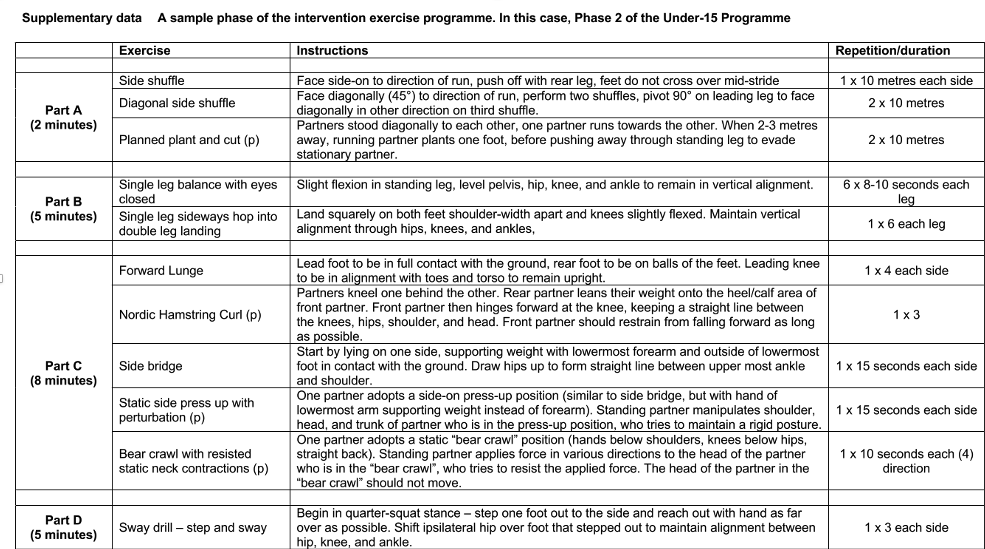
Neuromuscular warm up that has been shown to decrease concussion rates.
This type of warm-up has another benefit: the same qualities that may reduce injury risk often support better performance.
Better balance, strength, landing control, and deceleration are not just “injury prevention” traits. They are athletic traits.
For athletes, this message matters:
The things that keep you healthy often help you perform better, too.
Strategy 4: Support Safer Rules and Smarter Contact Exposure
Rules matter.
This can be a sensitive topic in competitive sports, especially when rule changes are perceived as making the sport “softer” or less competitive. But the evidence from multiple sports suggests that rules and contact exposure can meaningfully affect concussion rates.
In youth and adolescent ice hockey, removing body checking has been associated with lower concussion rates during games. Importantly, more years of body-checking experience has not clearly been shown to protect players from concussion.
In American football, limiting the number, duration, and intensity of contact practices has been linked with lower rates of practice-related concussion.
For clinicians, this creates an important educational opportunity.
Safer rules do not mean weaker athletes.
They mean smarter systems.
Athletes still need skill development, physical preparation, confidence, and sport-specific exposure. But unnecessary or excessive head-impact exposure should not be treated as a requirement for toughness.
From a systems perspective, concussion risk reduction should include:
Thoughtful contact practice limits
Age-appropriate rules
Enforcement of dangerous play penalties
Coach education
Technique instruction
Removal from play when concussion is suspected
Clear return-to-play processes
When clinicians communicate with schools, parents, and sports organizations, the emphasis should be on balancing performance, participation, and safety.
Clinical Application: How Healthcare Professionals Can Use This Information
For clinicians, concussion risk reduction should not be reduced to a single recommendation like “buy a better helmet.”
A more effective approach is to think in layers.
1. Equipment Layer
Ask whether the athlete is using appropriate, well-fitted, sport-specific equipment.
This includes helmets, mouthguards, and any other protective equipment required by the sport.
2. Movement Layer
Evaluate the athlete’s movement quality, especially balance, landing mechanics, cutting control, neck/trunk control, and fatigue-related changes in mechanics.
This is where rehabilitation professionals can contribute significantly.
3. Training Layer
Encourage teams to use consistent neuromuscular warmups and provide feedback on quality, not just completion.
4. Rules and Exposure Layer
Educate coaches and organizations on the importance of age-appropriate rules, appropriate contact limits, and reducing unnecessary head-impact exposure.
5. Culture Layer
Athletes need to know that speaking up after a head impact is not a sign of weakness. It is part of protecting their health, performance, and future participation.
Clinicians can help shape this culture by using clear, consistent language:
“We may not be able to prevent every concussion, but we can reduce risk and respond better when concussion happens.”
Key Takeaways
Concussion prevention should be framed as risk reduction, not complete elimination.
Helmets can reduce risk, but they do not make athletes concussion-proof.
Mouthguards are primarily used for dental and jaw protection, but they may provide another layer of protection in some sports.
Neuromuscular warmups are a practical, performance-friendly strategy that may reduce injury risk and improve movement quality.
Rules and contact exposure matter. Safer sport structures can reduce concussion risk without reducing athlete development.
Clinicians play an important role in helping athletes, parents, coaches, and organizations implement realistic systems that lower risk.
FAQ: Can We Prevent Concussions?
Can concussions be completely prevented?
No. It is not realistic to say that every concussion can be prevented, especially in sports or activities involving speed, contact, falls, or collisions. A better goal is to reduce concussion risk through multiple layers of protection.
Do helmets prevent concussions?
Helmets do not make athletes concussion-proof. They are important for head protection and may help reduce concussion risk, but they cannot eliminate the forces that cause concussion. Proper fit, sport-specific design, and consistent use are essential.
Do mouthguards prevent concussions?
Mouthguards are primarily used to protect the teeth and jaw. Some research suggests they may be associated with lower concussion rates in certain sports, but they should be viewed as one part of a broader risk-reduction strategy.
What type of warmup helps reduce injury risk?
A neuromuscular warmup that includes balance, strength, landing control, cutting mechanics, and sport-specific movement is more useful than a simple jog-and-stretch routine. The quality of movement and coach feedback are important.
Do rule changes really reduce concussion risk?
Rule changes can affect concussion rates, especially when they reduce unnecessary high-risk contact or limit excessive head-impact exposure. Examples include removing body checking in certain youth hockey settings and limiting contact practices in football.
What should athletes do if they hit their head or do not feel right?
They should speak up right away and be removed from play for appropriate evaluation. Continuing to play with concussion symptoms can increase risk and delay recovery.
Conclusion: Prevention Is Not Perfect, But Risk Reduction Matters
We may not be able to prevent every concussion.
But that does not mean we are powerless.
Healthcare professionals can help athletes and communities lower concussion risk by promoting better equipment decisions, consistent mouthguard use, structured neuromuscular warmups, safer rules, and a culture where athletes feel comfortable reporting symptoms.
The goal is not to create fear around sport. The goal is to help athletes stay healthy, stay active, and stay available.
Because in sports, one of the best abilities is availability.
And protecting the brain is one of the most important parts of long-term athlete development.
Want to improve your clinical confidence with concussion evaluation, treatment, and return-to-play decision-making?
Concussion Spot Education provides practical, evidence-informed continuing education for healthcare professionals working with concussion, headache, and vestibular rehabilitation.
Explore our courses and resources to build a more systematic approach to concussion care.